
Stationery Analyses
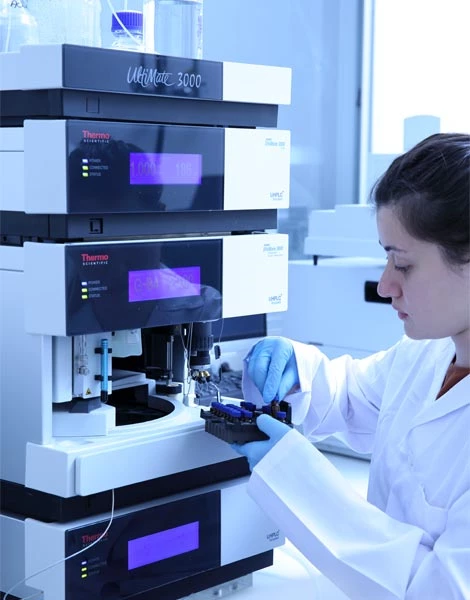
As in all products we use, stationery products may contain harmful chemicals that we should be aware of such as Azo Dyes, Phthalates, Heavy Metals, Allergen Dyes, Carcinogenic Dyes, Formaldehyde, Nickel and PAH's, Benzene, Toluene. In our laboratory, the detection of all the above-mentioned harmful chemicals can be easily detected with our state-of-the-art instrumental devices equipped with superior technology and our expert staff.
Stationery Analyses Deney Tablosu
Stationery - Determination of Volatile Organic Compounds by GC-MS (Benzene)
In-house Method - AY-EKL-101/Rev.00 (modified from ASTM D5769)
2 pieces
Stationery - Quantification of Phthalates (using GC-MS)
CPSC-CH-C1001-09.4
2 pieces
Stationery - Determination of Polyaromatic Hydrocarbons (PAHs)
TSE CEN ISO/TS 16190
2 pieces
Stationery - Determination of Nickel Release from Products that Can Come into Direct and Prolonged Skin Contact (using ICP- MS)
BS EN 1811
2 pieces
Stationery - Determination of Free and Hydrolysed Formaldehyde
BS EN ISO 14184-1 ISO14184-1 EN 71-9 + A1 Article 4.3.1
2 pieces
Stationery - Determination of Carcinogenic Dyestuffs
DIN 54231
2 pieces
Stationery - Heavy Metal Determination of Metal Samples by Heater or Microwave Method (Pb)
CPSC-CH-E1001.08.3
2 pieces
Stationery - Determination of Total Lead (Pb) in Metal Child Products
CPSC-CH-E1001.08
2 pieces
Stationery - Analysis of Total Lead (Pb) in Non-Metal Children's Products
CPSC-CH-E1002.08
2 pieces
Stationery - Determination of Extractable Cadmium
CPSC-CH-E1004-11
2 pieces
Determination of Lead (Pb) released into artificial saliva solution (using ICP-MS)
EN 16711-3 BS EN 16711-3 TS EN 16711-3
2 pieces
Stationery - (wooden products)-Detection of Heavy Metals by Heater or Microwave Method Arsenic (As)
In-house Method - AY-EKL-25/Rev.00 (modified from EPA 3051)
2 pieces
Stationery - (wooden products) - Determination of Heavy Metals by Heater or Microwave Method Mercury (Hg)
In-house Method - AY-EKL-26/Rev.00 (modified from EPA 3051)
2 pieces
Stationery - (Textile Products and Toys Containing Them) - Toy Safety, Chapter 9: Organic Chemical Compounds, Determination of Flame Retardants (using LC-MS-MS)
TS EN 71-9+A1 Chart 2A BS EN 71-9+A1 Chart 2A EN 71-9+A1 Chart 2A TS EN 71-10 Article 8.1.1 BS EN 71-10 Article 8.1.1 EN 71-10 Article 8.1.1 BS EN 71-11 Article 5.2 TS EN 71-11 Article 5.2 EN 71-11 Article 5.2
2 pieces
Stationery - (Textile, Leather, Wood, Paper, Cardboard, Liquid Products and Toys Containing These and Solid Toy Materials Designed to Leave Marks, Materials such as Modelling Clay, Play Dough, Balloons, Adhesive Imitation Tattoos)-Organic Chemical Compounds, Determination of Colorants (using LC-MS-MS)
EN 71-9 + A1 Table 2B EN 71-10 Art. 8.1.3 EN 71-10 Art. 8.2.1 EN 71-10 Art. 8.3.1 EN 71-10 Art. 8.4.1 EN 71-10 Art. 8.5.1 EN 71-10 Art. 8.6.1 EN 71-10 Art. 8.7.1 EN 71-10 Art. 8.8.1 EN 71-10 Art. 8.9.1 EN 71-11 Art. 5.3
2 pieces
Stationery - (Textile, Leather, Wood, Paper, Cardboard, Liquid Products and Toys Containing These and Solid Toy Materials Designed to Leave Marks, Materials such as Modelling Clay, Play Dough, Balloons, Adhesive Imitation Tattoos) - Organic Chemical Compounds, (Primary) Primary Aromatic Amines determination (using GC-MS)
EN 71-9 + A1 Table 2C EN 71-10 Art. 8.1.4 EN 71-10 Art. 8.2.2 EN 71-10 Art. 8.3.2 EN 71-10 Art. 8.4.2 EN 71-10 Art. 8.5.2 EN 71-10 Art. 8.6.2 EN 71-10 Art. 8.7.2 EN 71-10 Art. 8.8.2 EN 71-10 Art. 8.9.2 EN 71-11 Art. 5.4
2 pieces
Stationery - (Polymeric Product and Toys Containing Them)-Toy Safety, Chapter 9: Organic Chemical Compounds; Determination of Monomers (using LC-MS-MS, HPLC-DAD, GC-MS, UV-VIS)
TS EN 71-9+A1 Chart 2D BS EN 71-9+A1 Chart 2D EN 71-9+A1 Chart 2D TS EN 71-10 Article 6 BS EN 71-10 Article 6 EN 71-10 Article 6 BS EN 71-11 Article 5.5 TS EN 71-11 Article 5.5 EN 71-11 Article 5.5
2 pieces
Stationery - Leather, Liquids, Modelling Clay, Play Clay and Similar, - Toy Safety, Chapter 9: Organic Chemical Compounds, Determination of Preservatives (using HPLC-DAD, UV-VIS)
TS EN 71-9+A1 Chart 2H BS EN 71-9+A1 Chart 2H EN 71-9+A1 Chart 2H TS EN 71-10 Article 8.5.3/8.7.3/8.9.3 BS EN 71-10 Article 8.5.3/8.7.3/8.9.3 EN 71-10 Article 8.5.3/8.7.3/8.9.3 BS EN 71-11 Article 5.7 TS EN 71-11 Article 5.7 EN 71-11 Article 5.7
2 pieces
Stationery - (Polymeric Product and Toys Containing Them)-Organic Chemical Compounds, Determination of Plasticizers (Migration) (using GC-MS)
EN 71-9 +A1 Table 2I EN 71-10 Art. 6 EN 71-11 Art. 5.8
2 pieces
Frequently Asked Questions
-
What is Stationery Analysis?
Stationery analysis involves testing the physical and chemical properties of pens, erasers, paints, notebooks, and other stationery items in a laboratory. These analyses determine safety and regulatory compliance, especially for products intended for children.
-
Why Are Stationery Tests Conducted?
Stationery tests protect users’ health, detect harmful substances, verify quality standards, and ensure safe market placement. They also help obtain necessary documents for import and export processes.
-
What Tests Are Conducted on Stationery Products?
Stationery tests include heavy metal analysis, phthalate testing, azo dye testing, and physical durability tests. Flammability and mechanical safety tests may also be applied. Test scope varies depending on product type and intended use.
-
What is Heavy Metal Testing in Stationery Products?
Heavy metal testing detects elements like lead, cadmium, and mercury that are harmful to human health. It is critical for paints, markers, and erasers. These tests are evaluated against limits to protect children’s health.
-
Why is Phthalate Testing Important in Stationery Products?
Phthalates are chemicals used to provide flexibility in some plastic products but can negatively impact health. Therefore, phthalate testing is important for plastic-coated notebooks, pencil cases, and erasers.
-
Are Tests Required for CE Certification of Stationery Products?
Some stationery products may fall under toy regulations and require CE certification. Laboratory tests must be conducted according to relevant safety standards. Test reports document regulatory compliance.
-
According to Which Standards Are Stationery Analyses Performed?
Stationery analyses are performed according to national and international safety standards depending on the product type. Chemical safety criteria are particularly considered for children’s products.
-
Which Tests Are Performed on Colored Pencils?
Colored pencils undergo heavy metal testing, chemical content testing, and durability tests. Safety for skin contact is also evaluated, especially in preschool products.
-
Which Analyses Are Done on Erasers and Plastic Products?
Erasers and plastic stationery products are tested for phthalates, heavy metals, and chemical content. Physical durability and fragmentation risk are also assessed to ensure user safety.
-
How Long Does Stationery Analysis Take?
The duration depends on the scope of tests. Simple chemical analyses can be completed in a few days, while comprehensive test processes may take longer. Sample quantity and lab workload affect timing.
-
How Are Stationery Analysis Prices Determined?
Prices vary by test type, number of samples, and required standards. Chemical content testing is generally more expensive. Accurate analysis prevents legal penalties and product recalls.
-
Are Tests Mandatory for Imported Stationery Products?
Imported stationery products must comply with safety standards. Test reports may be requested during customs processes, making laboratory analyses important for importers.
-
Why Are Chemical Analyses Necessary for Stationery Products?
Chemical analyses detect substances that may pose health risks. Strict safety limits are applied for products intended for children, ensuring safe production and protecting brand reputation.
-
How Does the Stationery Quality Control Process Work?
The quality control process includes raw material inspection, production oversight, and final product testing. Laboratory analyses support compliance with safety standards.
-
What is an Accredited Stationery Laboratory?
An accredited stationery laboratory is authorized to perform tests according to international standards. Reports are officially valid and accepted in inspections, providing a key advantage for exporting companies.
Get in touch now
Contact our expert team for your R&D studies and testing needs, let's bring your projects to life together.