
Textile Analyses
The challenge you face as importers or manufacturers of textiles is to ensure that products are free of harmful substances in order to comply with worldwide chemical restrictions. By auditing each stage of the supply chain, you can implement key quality measures to protect your business and your customers. Particular attention should be paid to the selection of dyes and auxiliary chemicals. This includes ensuring the absence of harmful and hazardous chemicals.
With the solutions we offer, we not only offer testing services on materials and products, but also comprehensive consultancy and training services to protect the production process against the use of potentially problematic substances. Our knowledge of the restrictions currently being developed on chemicals, our technical competence and our commitment to understanding your needs form the basis of this assurance we offer.
Within the scope of product safety inspections in our country, we offer all Analysis services as accredited within the scope of the Communiqué on the Inspection of Some Textile, Apparel and Leather Products (Product Safety and Inspection: 2021/18).
Textile Analyses Deney Tablosu
Textile - pH Determination of Aqueous Extract (using pH meter)
TS EN ISO 3071
20 g
Textile - Determination of Free and Hydrolysed Formaldehyde (Water Extraction Method) (Using UV-VIS Spectrophotometer)
BS EN ISO 14184-1 ISO14184-1 EN 71-9 + A1 Article 4.3.1
Textile: 10 g / Paper: 40 g
Textile - Methods for the determination of certain aromatic amines derived from azo dyestuffs - Part 1: Detection of the use of certain azo dyestuffs obtainable in fibres with and without extraction (GC-MS Method)
ISO 14362-1
Per colour 5 g
Textile - Determination of Formaldehyde Content-Part 1 (using HPLC-DAD)
ISO/ 17226-1
Textile: 10 g / Paper: 40 g
Textile - Methods for the Determination of Certain Aromatic Amines Derived from Azo Dyes Part 3: Determination of the Use of Certain Azo Dyes That Can Reveal 4-Aminobenzene (using GC-MS,HPLC)
TS EN ISO 14362-3
Per colour 5 g
Textile - Determination of Dimethyl Fumarate in Shoe Components (DMFu) (using GC-MS)
ISO/TS 16186
20X20 cm or 5 g
Textile - Determination of Polychlorophenol Content in Leather and Textile Products Pentachlorophenol (PCP) Determination of Polychlorophenol Content in Leather and Textile Products Determination of Pentachlorophenol (PCP) Tetrachlorophenol (TCP) Trichlorophenol (TriCP) (GC-MS Method)
TS EN ISO 17070
10 g
Textile - Determination of Carcinogenic Dyes (using HPLC-DAD, LC-MS-MS)
DIN 54231
20 cm x 20 cm if it is coloured, it must include all colours (approximately 10 grams)
Textile - Determination of Phosphorus Flame Retardants (using LC-MS-MS) TCEP, TEPA,TRİS, TDCP,TCPP
In-house Method AY-EKL-102, ISO 17881-2 based
5 g
Textile - Determination of Poly Aromatic Hydrocarbons (PAHs) (using GC-MS)
In-house Method AY-EKL-048, AfPS GS 2019:01 based
2 g
Textile - Determination of Short Chain and Medium Chain Paraffins by Chromatographic Method (using LC-MS-MS)
In-house Method AY-EKL-045, ISO 18219 based
2 g
Textile - Determination of Lead (Pb) Released into Textile Coated Metal-Artificial Saliva solution (using ICP-MS)
EN 16711-3 BS EN 16711-3 TS EN 16711-3
5 g
Leather - Determination of Extractable Perfluorooctansulfanate (PFOS), Perfluorooctanoic Acid (PFOA) (using LC-MS-MS)
CEN/TS 15968
6 g
Leather - Determination of Alkyl Phenol (AP) and Alkyl Phenol Ethoxylates (APEO) in Leather, Textile and Process Auxiliary Products (using GC-MS)
In-house Method - AY-EKL-7/Rev.00, modified from ISO 18218-2
5 g
Rubber and Plastic - Coated Fabrics Determination of Elastic Resistance Flexometry Method
TS EN ISO 32100 EN ISO 32100 ISO 32100
For a single parameter 2 x A4 SIZE
Rubber and Plastic - Coated Fabrics Determination of Coating Adhesion
TS EN ISO 2411 EN ISO 2411
70 x 70 cm
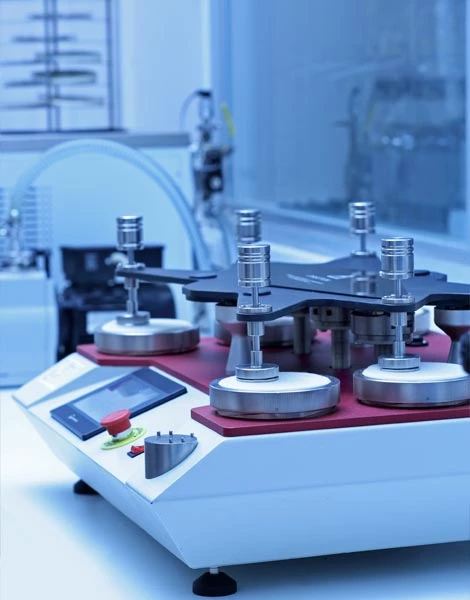
Determination of Abrasion Resistance of Rubber and Plastic - Coated Fabrics Using Martindale Abrasion Device
TS EN ISO 5470-2 Metot-2 EN ISO 5470-2 Metot-2 ISO 5470-2 Metot-2
2 x A4 SIZE
Rubber or Plastic - Coated Fabrics (Artificial Leather) - Determination of Tensile Strength and Elongation at Break
TS EN ISO 1421 EN ISO 1421 ISO 1421
70 x 70 cm
Determination of Tear Strength of Rubber or Plastic - Coated Fabrics (Imitation Leather) Constant Velocity Tear Methods
TS EN ISO 4674-1 ISO 4674-1 METOT B
60 x 60 cm
Imitation Leather - Coating Thickness Determination
In-house Method - AY-EFL-25/Rev.00, modified from ISO 2589
40 x 40 cm
Textile - Determination of Surface Pitting and Pilling Proneness in Fabrics Improved Martindale Method
TS EN ISO 12945-2 EN ISO 12945-2 ISO 12945-2
70 x 70 cm
Protective Gloves Against Mechanical Risks - Determination of Abrasion Resistance
TS EN 388 Article 6.1 EN 388 Article 6.1
3 PAIRS OF GLOVES
Protective Gloves Against Mechanical Risks - Determination of Tear Resistance
TS EN 388 Article 6.4 EN 388 Article 6.4
3 PAIRS OF GLOVES
Frequently Asked Questions
-
What is textile analysis?
Textile analysis tests the physical, chemical, and performance properties of fabrics and threads in a laboratory. It assesses durability, colorfastness, fiber content, and compliance with quality standards, playing a critical role in quality control and export processes.
-
Why is textile analysis important?
Textile analysis ensures product quality, improves customer satisfaction, and confirms compliance with national and international standards. Early detection of production errors reduces costs and strengthens brand reliability.
-
What laboratory tests are conducted on textiles?
Tests include strength testing, colorfastness, wash resistance, stretching, pilling, fiber analysis, and chemical content tests. These determine fabric performance and lifespan.
-
How is fabric durability tested?
Durability tests measure tensile, tear, and abrasion resistance using specialized equipment. Results indicate suitability for intended use, especially for workwear and sports fabrics.
-
What is colorfastness testing?
Colorfastness evaluates resistance to washing, rubbing, sweat, and light. It ensures fabrics do not fade or bleed, which is crucial for exports.
-
How is fiber analysis conducted?
Fiber analysis uses microscopic and chemical methods to identify cotton, polyester, viscose, wool, or other fibers, ensuring correct labeling and consumer confidence.
-
Which standards are textile analyses based on?
Textile analyses follow ISO and EN standards, as well as TSE criteria in Turkey. Internationally recognized protocols ensure global market suitability.
-
How does the textile quality control process work?
Quality control starts from raw materials and continues to the final product, including sampling, laboratory testing, and reporting, minimizing production errors and maintaining consistent quality.
-
What is the difference between physical and chemical textile tests?
Physical tests measure mechanical properties like durability and elasticity. Chemical tests evaluate fiber content, dye quality, and presence of harmful substances. Both provide comprehensive quality assessment.
-
How long does textile analysis take?
Duration depends on the tests. Basic physical tests may take hours, while detailed chemical analyses can last several days. Express services can speed up results.
-
What determines the cost of textile analysis?
Costs depend on the number of tests, sample quantity, and type of analysis. Accredited labs may charge more, but accurate analyses reduce long-term quality costs.
-
What is an accredited textile laboratory?
An accredited lab is authorized to perform tests according to international standards, providing reliable and officially recognized reports. Accreditation is critical for export-oriented companies.
-
Why are harmful substance tests done in textiles?
Harmful substance tests identify chemicals that could threaten human health, especially in baby and children’s products. They are essential for safe production and brand protection.
-
Is textile analysis required for export?
Many countries require pre-import quality and safety certificates, making textile analysis necessary. Products may not pass customs without proper documentation.
-
How are textile analysis results reported?
Results are provided in a detailed report including test methods and measurements. These reports serve as official quality documents for audits and export processes.
Get in touch now
Contact our expert team for your R&D studies and testing needs, let's bring your projects to life together.